
Why the city creates a glare problem unlike forest, desert, or ski slope
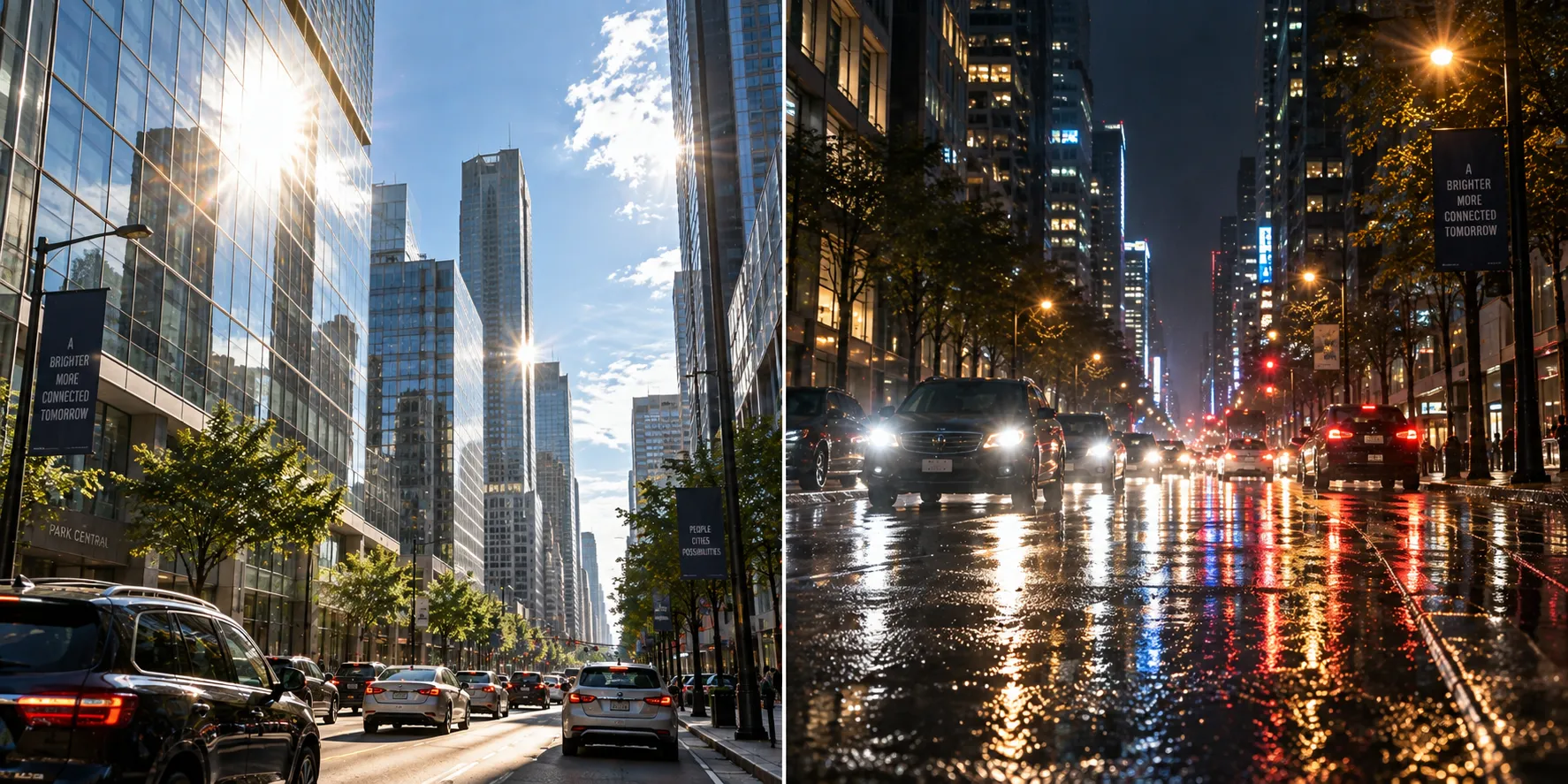
Fig. 1: Two different glare problems, one city: glass by day, wet asphalt by night.
Snow, desert, ocean, and forest each shift the color and intensity of light in their own way. The city produces something different again. Urban glare doesn’t come from one dominant light source the way sun on snow does. It comes from light bouncing off surfaces not designed to manage it, wet asphalt and glass towers, which multiply and redirect light in ways open landscapes typically don’t.
Two kinds of glare, and cities produce both
Vision scientists describe two effects. Disability glare is a reduction in visual performance caused by light scattered inside the eye, which lays a “veiling luminance” over the retinal image and reduces contrast. It’s measurable: it describes what a person can and can’t do. Discomfort glare is a sensation of annoyance or pain without necessarily impairing vision or visual performance, and it describes how a person feels. The distinction is largely a matter of how each is measured, and the two overlap. Disability glare depends on how much light from the source reaches the eye and how close the source sits to the line of sight. Discomfort glare is shaped by four main factors: the brightness of the source, the brightness of the background behind it, the size of the source, and where it sits in a person’s field of view. A city can change all four at once, compared with an open highway or a ski slope.
Wet asphalt can act like a mirror
Dry pavement scatters light diffusely. Add a thin film of water and the same surface starts behaving more like a mirror, reflecting headlights and streetlights back at drivers and pedestrians instead of scattering them. Researchers at Tongji University measured part of this in a laboratory test on coated asphalt samples: immediately after water was applied, the specular reflection coefficient rose by up to 1.5 times compared with the dry state. Separately, a DENSO and Hokkaido University study of night driving on wet roads describes wet road surfaces as acting like mirrors, and explains that the resulting glare behaves optically like a virtual object located below the road surface. In the footage the researchers worked with, that glare could completely obscure lane markings.
Glass buildings glare back
Reflective glass facades create a second, unrelated glare source. A study in Building and Environment by R. M. Aynsley concluded that glare from reflective glazing has a much greater effective range than reflected heat and should be considered over longer distances, in some cases kilometers, and noted that tall west-facing glass towers can cause significant glare late in the afternoon, when the sun is low. A building-physics consultancy case study, citing a limit attributed to Hassall (1991), uses a veiling luminance of 500 candela per square meter as a practical limit for safety, and identified one building whose early-morning reflections affected westbound drivers on a nearby road around 8 a.m. in April and August. Glass towers add a reflection source that open snow and desert landscapes lack.
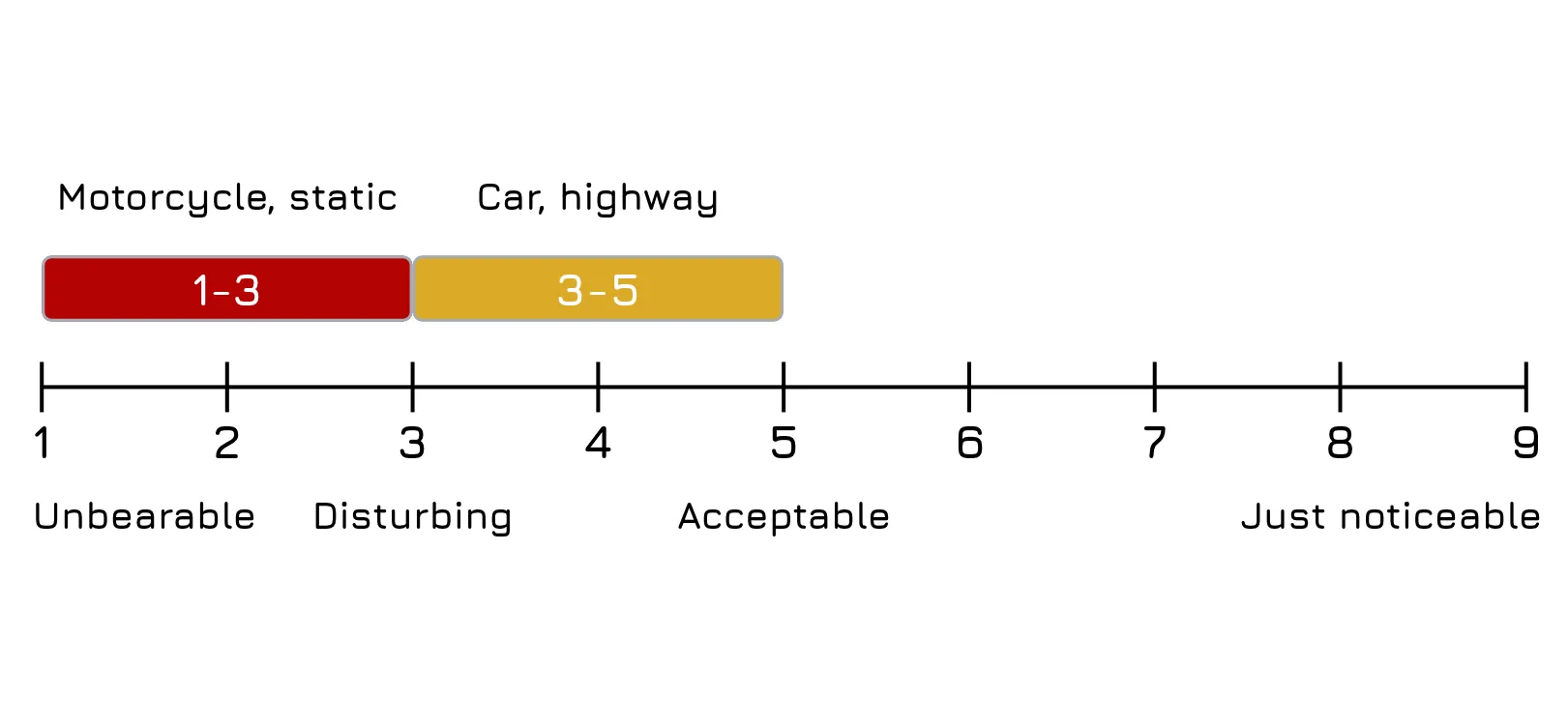
Fig. 2: The De Boer discomfort-glare scale showing a stopped motorcycle headlight (1 to 3) rated worse than an open-highway headlight (3 to 5).
The De Boer scale, applied to the city
The De Boer rating is a discomfort-glare scale used in night-driving glare research. In one study (Paripurna, 2009), car headlamps viewed by drivers on a highway without barriers scored 3 to 5, disturbing to acceptable, while motorcycle lamps in a static position scored 1 to 3, unbearable to disturbing. A stationary light at close range, like a motorcycle headlight beside a driver at a city intersection, may therefore be harder to look at than car headlights at highway distance, though this is one study and not a general rule. It also fits the discomfort-glare factors above: a source closer to a person’s line of sight tends to produce more discomfort than a distant one.
In one study, stationary motorcycle lamps scored worse on the De Boer scale than car headlamps on a highway.
A motorcycle headlight at a stoplight can be harder to look at than a car’s headlights on the open highway.
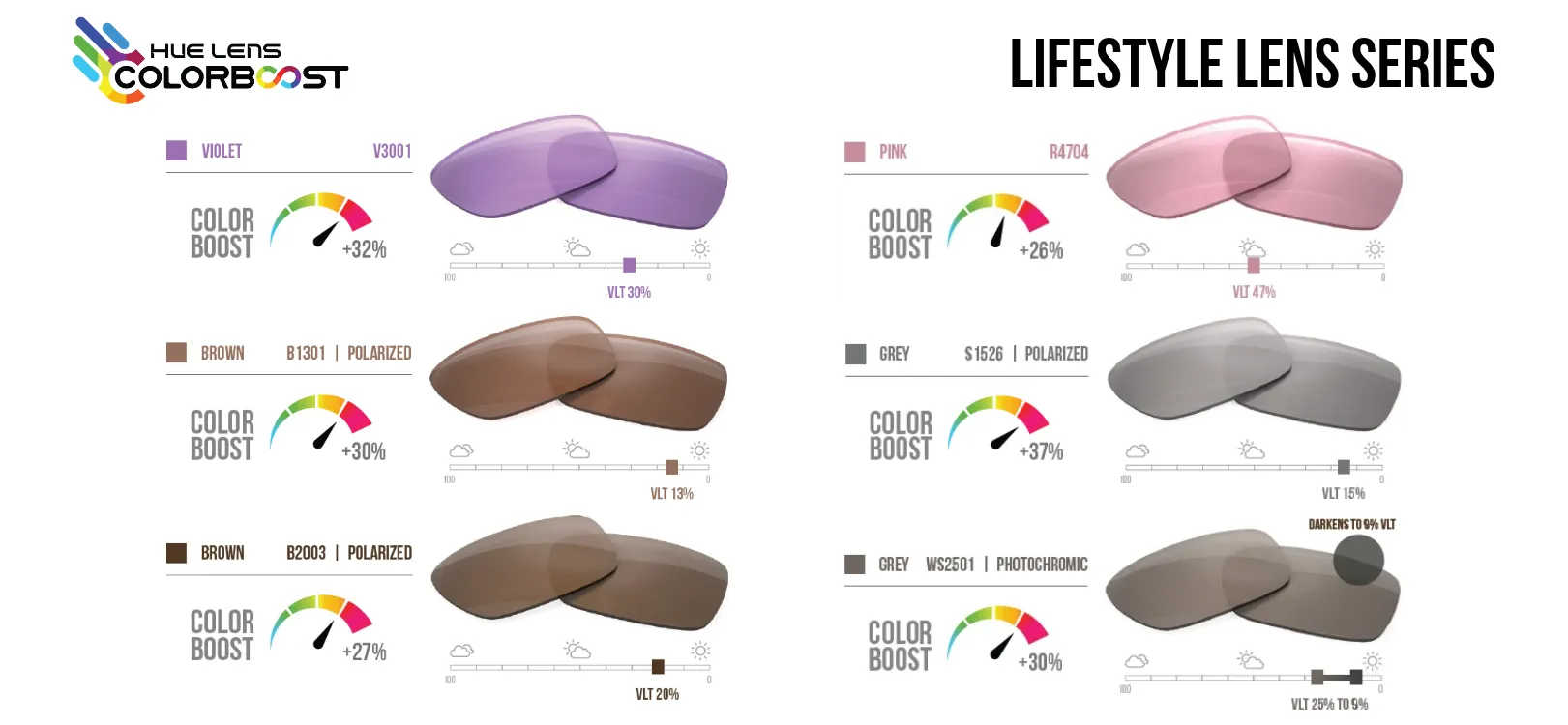
Fig. 3: Hue Lens Colorboost’s Lifestyle lens series, with tints designed for varying urban light conditions. Picture: Hue Lens Colorboost
Colorboost's take on the city
Wet-pavement reflection and building glare are measurable optical problems, distinct from the discomfort-glare source Colorboost’s night-driving research was built around, and distinct again from the color-shift problem behind its snow and water lenses. The Lifestyle Lens Series is built around that same everyday variability, a single day of city light that swings between unrelated glare sources rather than one steady condition. The lineup includes lighter lenses suited to changeable, overcast city light, a polarized option that reduces glare from reflections off horizontal surfaces such as wet pavement, and a photochromic lens that adjusts as light levels change over the day, rather than relying on one fixed lens for every condition.
If a stopped motorcycle headlight can rate worse than a car’s headlights at highway speed, does rating a lens by overall darkness actually capture the problem? What would it mean for a lens to account for where the light is coming from, not just how much of it there is?
Sources: Age-related color vision abnormalities: Schneck, M.E., et al. (2014), Optometry and Vision Science 91(1):60, DOI 10.1097/OPX.0000000000000114 (Smith-Kettlewell Eye Research Institute); contributing factors summarized by the California Health Report,
https://www.calhealthreport.org/2014/02/24/difficulty-seeing-some-colors-becomes-more-common-as-people-age/; lead author’s statement on blue-yellow defects: ESCRS EuroTimes, https://www.escrs.org/eurotimes/colour-vision; share of blue-yellow failures: Healio, https://cm.healio.com/news/optometry/20140224/certain-color-deficits-found-to-be-common-among-with-age. Gradual decline in normal aging: Barbur, J.L. & Rodriguez-Carmona, M. (2016), “Color vision changes in normal aging,” in Elliott, A.J., Fairchild, M.D. & Franklin, A. (Eds.), Handbook of Color Psychology, Cambridge University Press, pp. 180-196 (accepted manuscript), https://openaccess.city.ac.uk/id/eprint/12513/. Lens transmittance and age: Boettner, E.A. & Wolter, J.R. (1962), “Transmission of the ocular media,” Investigative Ophthalmology 1(6):776-783, https://ec.europa.eu/health/scientific_committees/scheer/docs/sunbeds_co240n_en.pdf. S-cone share of the cone population: Weinrich, T.W., et al. (2017), “No evidence for loss of short-wavelength sensitive cone photoreceptors in normal ageing of the primate retina,” Scientific Reports 7:46346, https://doi.org/10.1038/srep46346. S-cone pathway changes with age: “Aging of human short-wave cone pathways,” UC Davis, https://escholarship.org/uc/item/03×60251; “Effect of age on short-wavelength sensitive cone electroretinogram and long- and middle-wavelength sensitive cone electroretinogram,” https://pure.fujita-hu.ac.jp/en/publications/effect-of-age-on-short-wavelength-sensitive-cone-electroretinogra/. Peripheral resolution decline (~14% per decade after the fifth decade, for both blue-yellow and achromatic patterns): Zlatkova, M., Coulter, E. & Anderson, R. (2003), “Short-wavelength acuity: blue-yellow and achromatic resolution loss with age,” Vision Research, https://pure.ulster.ac.uk/en/publications/short-wavelength-acuity-blue-yellow-and-achromatic-resolution-los-3/. Debate and compensation: “The Verriest Lecture: Short-wave-sensitive cone pathways across the life span,” Journal of the Optical Society of America A 33(3):A104-22 (2016), https://pubmed.ncbi.nlm.nih.gov/26974914/; “Colour Constancy Across the Life Span: Evidence for Compensatory Mechanisms,” PLoS ONE (2013), https://doi.org/10.1371/journal.pone.0063921. CRF definition: Colorboost brand materials.