
The real reason modern headlights feel harsher, and it's not just brightness
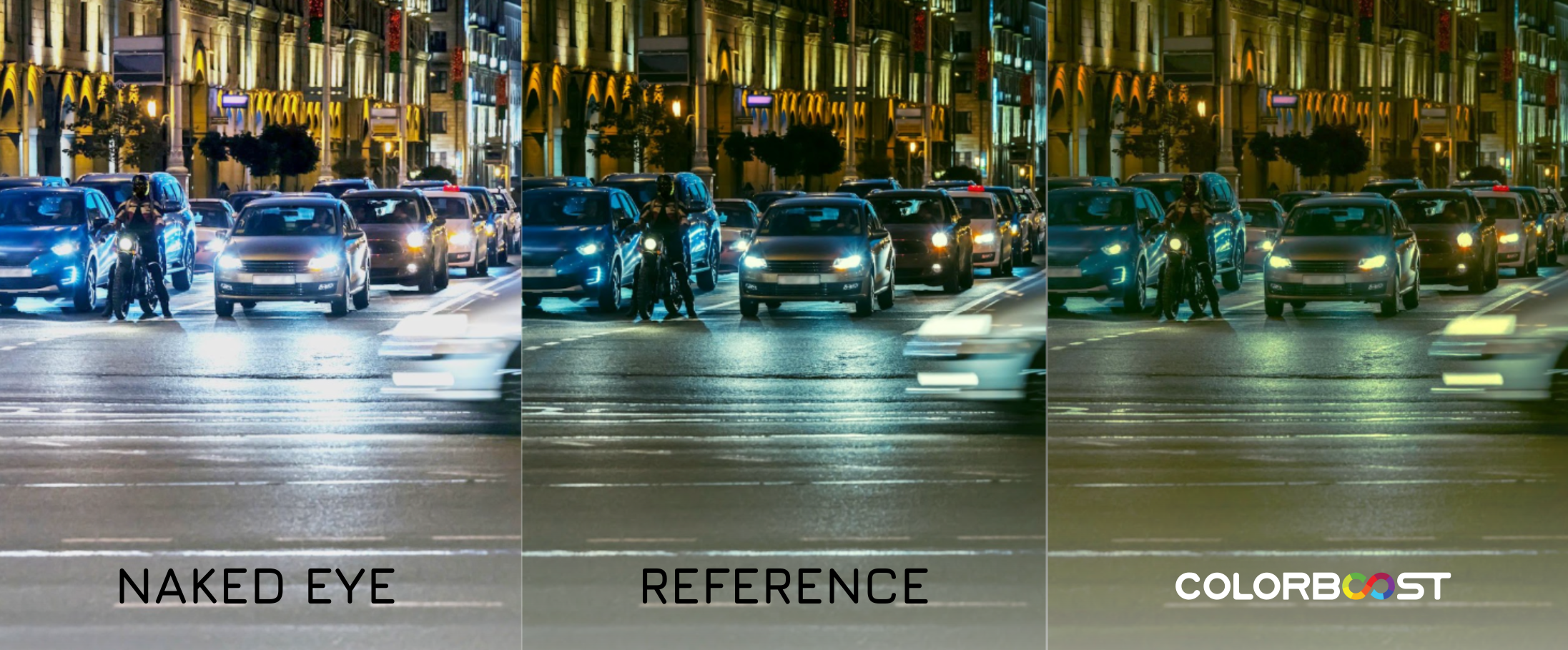
Fig. 1: Naked eye vs. a reference lens vs. Colorboost lens, a scientific image simulation based on measured lens data.
For most of the history of sunglasses, cutting glare meant one thing: making the lens darker. That instinct works reasonably well for daytime glare. Discomfort glare from oncoming headlights at night is a different, stranger problem, one that doesn’t scale the way brightness does, and the reason why has only been well understood in the last few decades of vision research.
How do you even measure discomfort?
Discomfort glare is subjective almost by definition, so researchers needed a shared scale to study it at all. The De Boer scale, developed by J. de Boer in 1967, is a nine-point rating system, 1 meaning unbearable, 9 meaning just noticeable, with descriptive labels at each odd number. It remains the most widely used tool in night-driving glare research today, which is how researchers have been able to compare headlight designs, lens tints, and road lighting against each other with any consistency at all.
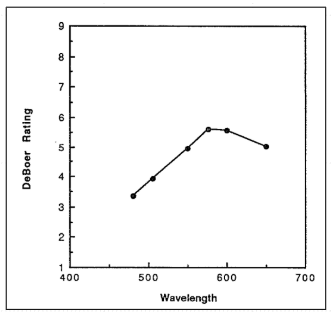
Fig. 2: De Boer rating vs. wavelength, discomfort glare independent of brightness (Flannagan et al., 1989, 1994).
It's not just how much light. It's which wavelengths.
Research from the University of Michigan Transportation Research Institute (Flannagan et al., 1989, 1994) found that specific wavelengths of light produce measurably more discomfort glare than others, independent of overall brightness. Two light sources can measure identically on a light meter and still earn very different De Boer ratings, because discomfort tracks the color composition of the light as much as its intensity.
The blue-light connection
A 2005 University of Michigan Transportation Research Institute study found that discomfort ratings were linearly related to the amount of blue content in a headlamp’s light output, weighted by the spectral sensitivity of the eye’s blue-sensitive cone photoreceptors (S-cones). The same study found that LED headlights, which emit more of that short-wavelength, blue-rich light than older halogen bulbs, produced measurably more discomfort glare than halogen headlights, even when matched for brightness. The “harsher” feeling many drivers report from newer headlights isn’t imagined. It has a specific, measured wavelength signature.
How uncomfortable a headlight feels correlates more closely with its blue-light content than with how bright it actually is.
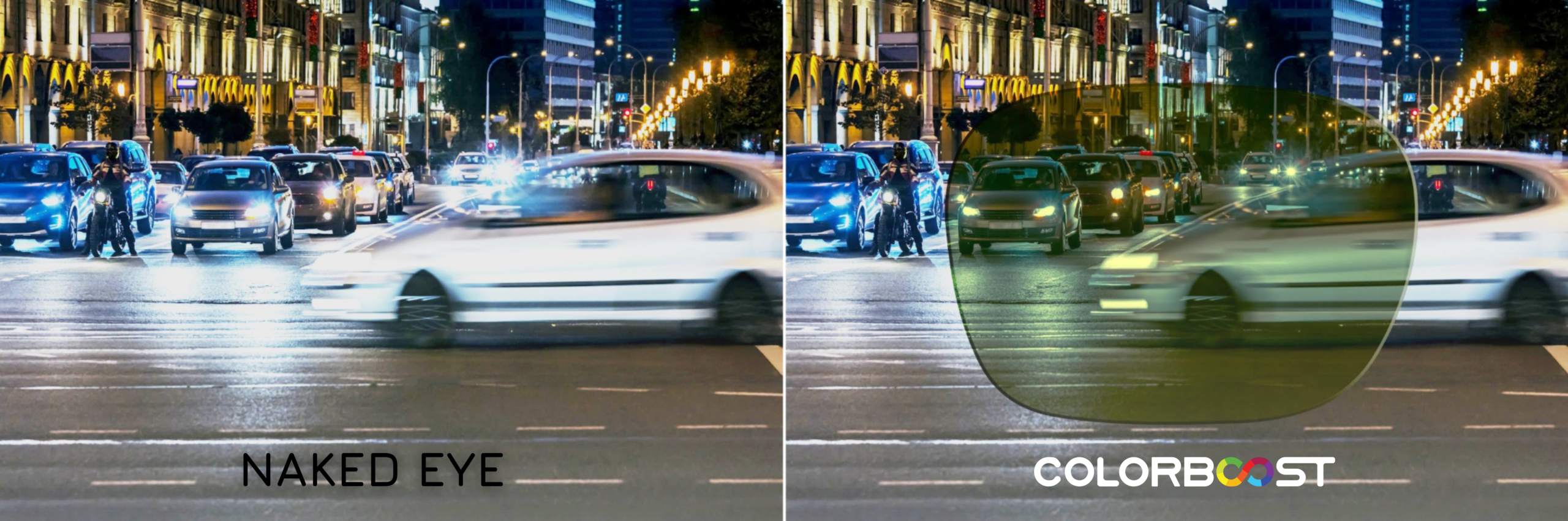
Fig.3: Naked eye vs. Colorboost lens in the same night-driving scene, a scientific image simulation based on measured lens data.
How Colorboost designs around it
Colorboost’s night-driving lens development is built around a merit function that combines De Boer rating research, spectral data from actual automotive headlights, and mesopic VLT, the visibility measure relevant to real night-driving conditions. The goal is targeting the specific wavelengths this research has identified as the real drivers of discomfort, rather than simply darkening the lens until glare drops.
If two headlights can look equally bright and still feel completely different to sit behind, what does that say about rating a lens by darkness alone? If a lens only measures how much light it blocks, is it actually measuring the thing that makes night driving uncomfortable in the first place?
Sources: De Boer scale: De Boer, J. (ed.) (1967), Public Lighting. Wavelength-discomfort relationship: Flannagan, M.J., et al. (1989), “Effect of wavelength on discomfort glare from monochromatic sources,” and Flannagan, M.J., Sivak, M., & Traube, E.C. (1994), “Discomfort glare and brightness as functions of wavelength,” University of Michigan Transportation Research Institute. Blue content, S-cone correlation, and LED vs. halogen discomfort glare: Sivak, M., Schoettle, B., Minoda, T., & Flannagan, M.J. (2005), “Blue content of LED headlamps and discomfort glare,” University of Michigan Transportation Research Institute, Report No. UMTRI-2005-2, http://deepblue.lib.umich.edu/handle/2027.42/57444. Merit-function methodology (De Boer rating, headlight spectral data, mesopic VLT): Hue Lens Colorboost night-driving lens development materials.