
The split-second science behind how your eyes actually detect danger
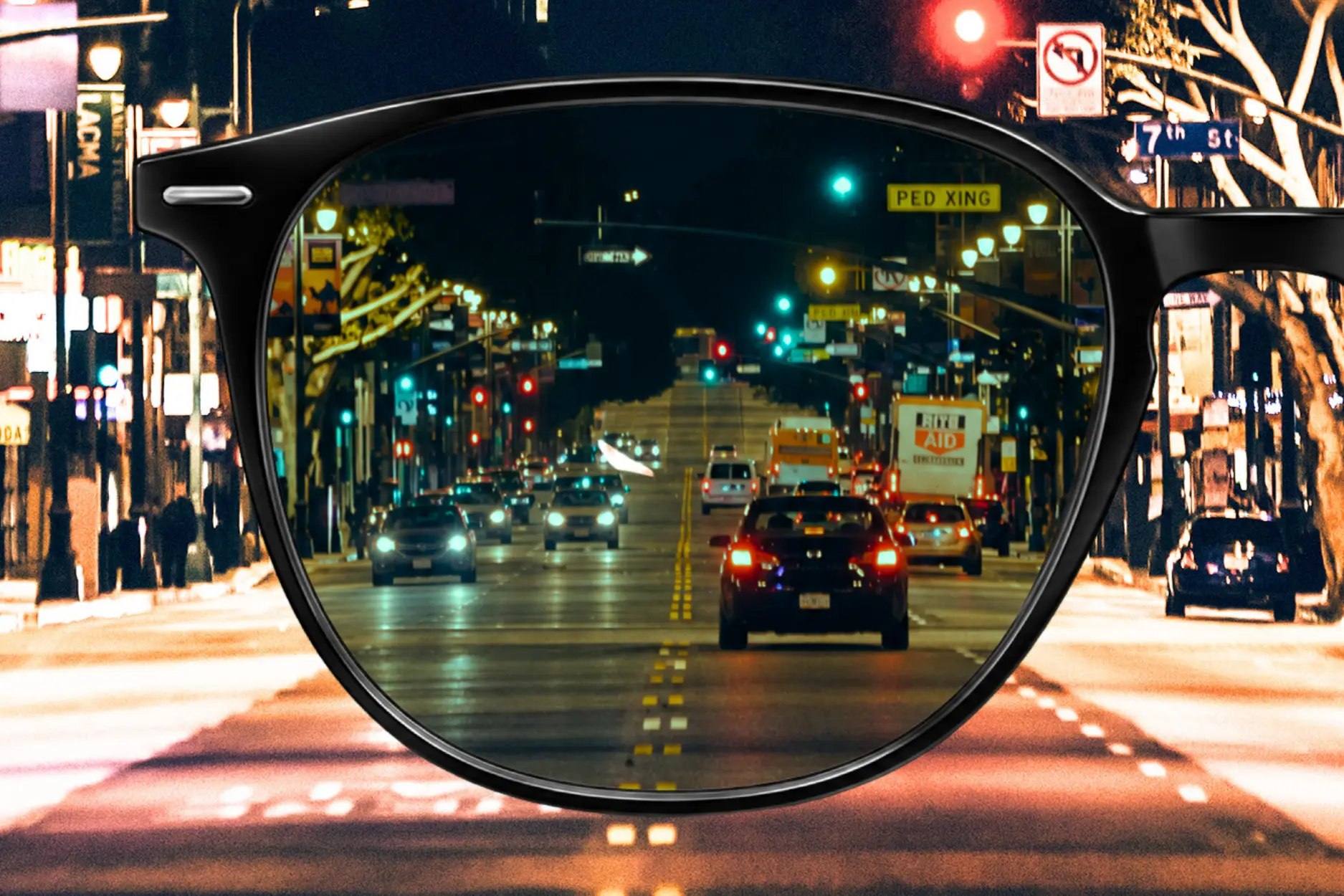
Fig. 1: A night driving scene through Hue Lens Colorboost, brake lights, pedestrians, and traffic signals.
A brake light against a lit-up strip mall. A pedestrian in a gray jacket against a gray sidewalk at dusk. A cyclist’s jersey against wet asphalt. These are the ordinary, split-second visual judgments a driver’s eye makes dozens of times per trip, and the science behind how they actually happen is stranger, and faster, than it feels.
Color doesn't wait for your attention
Psychologist Anne Treisman’s Feature Integration Theory, developed with Garry Gelade in 1980, found that the brain processes certain basic visual features, color among them, automatically and in parallel across the entire visual field, before conscious attention gets involved. Color is one of a small set of properties the visual system can detect this way, often called the “pop-out” effect: a red object registers almost instantly, in roughly 50 to 200 milliseconds, and it doesn’t take meaningfully longer to spot even as a scene gets more cluttered. Tasks that require combining features, matching a specific shape to a specific color, for instance, are far slower, because they require conscious, one-at-a-time attention instead.

Fig.2: A moving car shown at the moment color registers versus the moment motion does, roughly 50 to 100ms apart (Moutoussis & Zeki, 1997).
Color even beats motion to the brain
It goes further than that. Vision researchers Christoph Moutoussis and Semir Zeki found that the brain registers color measurably before it registers motion, by roughly 50 to 100 milliseconds, even when both are properties of the exact same moving object. Different visual attributes are processed along somewhat separate pathways in the brain, and they don’t all finish at the same time. Color consistently finishes first.
The brain registers color roughly 50 to 100 milliseconds before it registers motion, even when both come from the exact same object.
Why milliseconds actually add up on the road
According to NHTSA driver-safety data, the average driver takes about 1.5 seconds to perceive a hazard and physically react to it, roughly three-quarters of a second to notice the danger, and another three-quarters of a second to move a foot to the brake. At 55 mph, that’s already 121 feet of road covered before the car even begins to slow down. Traffic engineers build in an even larger safety margin: AASHTO’s design standard allows a full 2.5 seconds of perception-reaction time, specifically because reaction speed varies so widely between individual drivers. At highway speeds, a fraction of a second in earlier detection is the difference between a hazard registering with room to spare and one registering too late.
What today's lens specs don't measure
Sunglasses have historically been described by a narrow set of values: visible light transmission (VLT), UV protection, and polarization. None of them describe how easily a wearer can tell one color apart from a similar one nearby, the exact ability behind everything above. It’s a genuine gap in how lenses have been measured for most of the industry’s history.

Fig. 3: How displays describe color performance.
Colorboost's answer to that gap
Colorboost developed the Color Resolution Factor (CRF) specifically to put a number on that ability: how many meaningfully different colors a lens lets a wearer resolve, compared with a clear reference lens. It’s a step toward closing the measurement gap above, though the direct link between CRF and measured driving reaction time is still an open research question, not yet a proven one.
If color reaches your brain before you’re even consciously aware of it, and before motion does, what does it mean that the lens on your face has never been measured for that ability? In the moment it matters most, what might you already be missing?
Sources: Treisman, A. & Gelade, G. (1980), “A feature-integration theory of attention,” Cognitive Psychology, 12, 97-136; Treisman, A. (1985), “Preattentive processing in vision,” Computer Vision, Graphics, and Image Processing, 31(2), 156-177. Moutoussis, K. & Zeki, S. (1997), “A direct demonstration of perceptual asynchrony in vision,” Proceedings of the Royal Society B, https://www.ncbi.nlm.nih.gov/pmc/articles/PMC1688275. Driver perception-reaction time and stopping distance: NHTSA, “Speed and Stopping Distance,” https://www.ca1.uscourts.gov/sites/ca1/files/citations/S1N_Speeding-August2015_812008.pdf. AASHTO 2.5-second perception-reaction design standard: summarized at https://physicsforums.com/tags/stopping-distance/wiki.